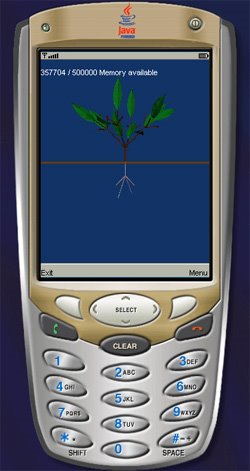
 Hello. Back to reality after some months of hard works on a book that will be published during next spring. More information later. In this post, I will rather focus on a new project we have begun with my friend Claude Lattaud of Paris V university. This project is called the "green tamagotchi project" after the great commercial success of Bandai's game. The idea is to take care of a plant on your mobile phone. You will be able to change light, put water, some fertilizer, and see the growth of a virtual plant. After some days you'll get a beautiful plant with green leaves and flowers. You could then send it to your wife for her birthday or add it to your virtual garden on your PC... There will be a large variety of seeds and you will be also able to create new species. We used an advanced 3D L-System engine for the artificial life part of the project. The image shows a view of the work in progress prototype on a mobile phone simulator. We also work on the user interface that must be usable by any mobile phone owner. Any company interested in this project can contact me...
Saturday, October 21, 2006
Virtual Plants on Mobile Phones
Hello. Back to reality after some months of hard works on a book that will be published during next spring. More information later. In this post, I will rather focus on a new project we have begun with my friend Claude Lattaud of Paris V university. This project is called the "green tamagotchi project" after the great commercial success of Bandai's game. The idea is to take care of a plant on your mobile phone. You will be able to change light, put water, some fertilizer, and see the growth of a virtual plant. After some days you'll get a beautiful plant with green leaves and flowers. You could then send it to your wife for her birthday or add it to your virtual garden on your PC... There will be a large variety of seeds and you will be also able to create new species. We used an advanced 3D L-System engine for the artificial life part of the project. The image shows a view of the work in progress prototype on a mobile phone simulator. We also work on the user interface that must be usable by any mobile phone owner. Any company interested in this project can contact me...
Monday, May 29, 2006
3D Biomorphs
 As some of you may probably know, I am very interested in Biomorphs since the design of the Lifedrop virtual ecosystem (see the LifeDrop page on the right). In LifeDrop, the virtual water drop is like a 3D sphere with simple physical simulation. Biomorphs are true autonomous agents and their 3D shapes are based on the original Richard Dawkins recursive procedure simply called Tree in the Blind Watchmaker program. Concerning the 3D rendering, I have just made a small adaption to this original 2D routine in order to have some "legs" in 3D. However, I am not very satisfied by this approach. I would be very interested if someone has already found a better way for drawing 3D Biomorphs. The problem is that procedure not only needs to show the same properties as in 2D, but also a much better rendering. As an example of a better rendering in 2D, the image shows "Mandelbrotset Biomorph" which has been computed using Mathematica (see http://www.bugman123.com/Fractals/Fractals.html for details). However, since LifeDrop runs multiple Biomorphs agents in parallel, the drawing procedure must be optimized to obtain fast rendering. All theses points make the problem hard to solve. However, I think it is possible and when this point will be resolved, I will update LifeDrop.
Wednesday, April 26, 2006
Les indispensables
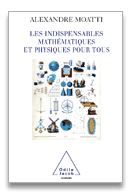 Une fois n'est pas coutume, un post en français car le sujet s’y prête. Il s’agit d’un coup de projecteur sur le livre d’Alexandre Moatti édité par Odile Jacob : Les indispensables – Mathématiques et Physiques pour tous. Un excellent livre de culture générale scientifique qui a le mérite de couvrir effectivement " les indispensables " : nombre d’or, nombres parfaits et amicaux, quadrature du cercle et courbes fractales, vitesse de la lumière et trous noirs, théorème de Gödel et relation d’incertitude, relativité et théorie du chaos. Même dans le domaine relativement pointu des créatures artificielles, et a fortiori pour tous ceux qui s’intéressent aux sciences de la complexité, la lecture rafraîchissante de ce livre apportera une perspective intéressante : il est possible en effet de présenter des concepts et des théories jugés souvent " trop compliqués " de façon simple et compréhensible, sans introduire un décalage entre le scientifique et l’honnête homme du XXIe siècle.
Tuesday, April 18, 2006
Daedalus and Artifical Creatures
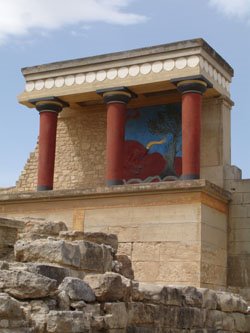 This is a photo of the Knossos's palace taken last week during my vacation in Crete : in greek mythology, this is the famous "Labyrinth" which was an elaborate maze constructed by King Minos of Crete and designed by Daedalus to hold the Minotaur, a man-eating monster that was half man and half bull. Daedalus is an important figure in the history of artificial creatures. He was a great architect and sculptor who's said to have created wooden "moving statues" and many other artifacts : he has built for Minos' wife, Pasiphae, a wooden cow so she could mate with the Minotaur ; he has fabricated wings for himself and his young son Icarus to escape from Crete, but Icarus flew too near the sun and fell into the sea. It is very difficult to know if Daedalus, like Minos itself, have really existed or if it is only a myth like many others in the antic greek legendary tales. However, the fact is that the palace exists and has been dated around 1700 B.C. (bronze age period) that is over 3500 years old.
Sunday, March 26, 2006
Eonomic Instability
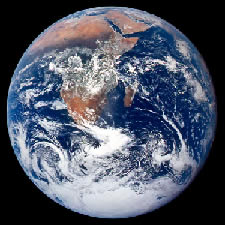 In this post, I want to focus on a very interesting paper published by Y. Louzoun et. al. in 2003 (Artificial Life vol. 9 n. 4 - MIT Press). Their paper shows that world-size global market lead to economic instability. The model is based on an extended Lokta-Voltera equation applied on a two-dimensional lattice with two main parameters: R is the range over which competition between agents can take place, and D is a diffusion coefficient of wealth. They argue that extreme values for globalization R and redistribution D, as advocated respectively by extreme capitalism and extreme socialism, are equally counterproductive and possibly disastrous due to catastrophic fluctuations. However, there is a regional globalization scale that seems to optimize the system. They conclude that moderate-size regional markets (R ~ system size / 10) partially protected from external competition, are the optimal economic configuration. Well, I would like to have enough time to be able to work on that subject. Interesting, no ? (Earth image from space - Courtesy Nasa).
Monday, March 13, 2006
Al-Jazari Automata
 Yesterday, I have visited the "The Golden Age of Arabic Sciences" exhibition at the Arabic World Institute in Paris. Among a very good selection of many scientific discoveries of this civilisation, it was an opportunity to see some documents written by Al-Jazari. Ibn Ismail Ibn al-Razzaz Al-Jazari (1206 AD) was one of history's greatest engineers. He invented many automata and some of the first mechanical clocks, driven by water and weights. He was called Al-Jazari after the area where he was born, Al-Jazira, which is the traditional Arabic name for northern Mesopotamia. Al-Jazari draws on the works of its predecessors both from the Greeks (Philon, Heron and Archimede) and Islamic world (Banu Musa brothers, Al-Khuwarizmi and Ridwan). His contribution was very important for the diffusion of knowledge in the Arabic world and after in Europe due to the translations of his books like "The Book of Knowledge of Ingenious Mechanical Devices" which contains more than 150 automata and mechanical devices. I take the picture in the museum showing a page of "A Compendium on the Theory and Practice of the Mechanical Arts" dated 1315-1316 (AD). The picture shows the internal structure of an automata for serving and arbitrating drinking sessions. That is to say that Al-jazira has an important place in the history of artificial creatures.
Saturday, March 11, 2006
Digital Life and Evolution
 In the famous Science-Fiction Hyperion book series written by Dan Simmons, the evolution of small virus programs in the Internet leads to the Infosphere. The story begins with Tom Ray’s Tierra project and ends with Artificial Intelligences, cybrids, and other virtual creatures. Is that possible ?
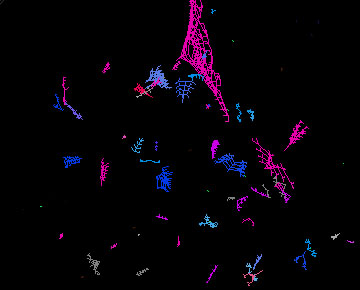
There is a long story of virtual ecosystems research projects : Tierra, Avida, LifeDrop and many others (left image shows a typical LifeDrop run - you can experiment it by following the LifeDrop link on the right). All these programs are based on the evolution of digital organisms by means of “digital DNA” mutations and cross-overs. Another characteristic is that these programs use a virtual machine layer between the computer operating system and the creatures. This virtual machine creates a more suitable environment for bio-inspired digital creatures and it represents also a sort of protection barrier between the system and the outside computer world. After more than a decade of research, some digital organisms are getting closer to fulfilling the definition of biological life : most of the features that biologists have said were necessary for life we can check off. These experiments raise multiple questions: What is the definition of life ? Are some of these digital creatures really alive ? Is the evolution in such systems really open-ended ? Is it possible to create digital organisms directly in the computer memory without any ecosystem simulation ? Well, I’ll try to address some of these important questions in future posts… Keep tuned.
Subscribe to:
Posts (Atom)